The Byblos Syllabary
The Byblos syllabary is an ancient undeciphered script with pecular properties and was discovered in 1928 at the Phoenician city state of Byblos, present day Lebanon. It is assumed to have been used to write Phoenician but nobody really knows whether this is true or not. The entire Byblos syllabary corpus is about 1100 characters long in total and is spread across about 14 inscriptions. Most of the contents of the Byblos syllabary corpus is made up of just two tablets named "c. and d.". On this page we will discuss a new attempt at decipherment by focusing on tablets c. and d. only.
History
Since the author isn't a professional epigraphist, best to leave the longest descriptions of the history of the Byblos Syllabary and other scripts of the 2nd millenium B.C. to others.
One could also describe here the entire history of previous attempts to decipher the Byblos Syllabary since its discovery. That would also prove lengthy for the "little progress made" in the past. It's safe to say however that each and every attempt brought more conclusions and information to the wider public on how the script worked.
It's helpful to know that the author has read descriptions of and gone through the most famous decipherment attempts and acknowledges the hard work and contributions of all. The main point of contention with previous attempts are:
- that the readings remain, well, unreadable.
- the inherent difficulty of the challenge means that any further attempts are now considered by many as -how to put it- brave.
- the current model for understanding ancient alphabets and their history are helpful overall but might be getting in the way of decipherment or new discoveries. This model is often based on a different undeciphered corpus of inscriptions. That corpus is actually mostly undeciphered or misunderstood.
Here we hope to change the decipherment status quo by adding many more constraints compared to previous attempts including making the resulting reading as interpretable as possible to readers of Phoenician/Ugaritic. We will also try to identify the princples of the script so that you, the reader can then work independently and by use of Phoenician and Ugaritic dictionaries as backup. Here's an example of such a book (in French):
https://geuthner.fr/livre/ugaritic-manual/840
It doesn't matter how flawed a method might or might not be, no Byblos Syllabary decipherments attempted so far have given us anything that is remotely interpretable as Phoenician or other languages considered related. Having a consistent reading of multiple words or phrases across both tablets c. and d. would therefore be a game changer even if incorrect.
Starting hypotheses for tablets c. and d.
Here I must mention and thank Françoise Briquel-Chatonnet for her 2022 Louvre Museum presentation. In it she explained how to emulate Abbé Barthélémy's decipherment of the Palmyrene and Phoenician alphabets for any other script. It is this method we apply here. The following information is therefore entirely hypothetical and should not be taken at face value. It is only designed to allow others to reproduce and test the decipherment attempt. We also make an effort to keep the hypotheses as short and naive as possible.
Language
If people in Byblos wanted to write Egyptian, they would have used hieratic. Cuneiform was used for Sumerian or Akkadian which the Byblos Syllabary was not. We therefore assume tablets c. and d. were used to write the most plausible languages in use at the time: Phoenician, Ugaritic or maybe Amorite which was a popular language of the time and region. Fortunately, Phoenician, Ugaritic and Amorite are considered close so we will just assume Phoenician here. This assumption can be further reinforced by the knowledge that Byblian king names predating alphabetical inscriptions are all Phoenician names.
Linguistic context
No bilingual inscriptions exist for the Byblos script which is the main obstacle to decipherment today. For this reason only, we could choose to stop the decipherment attempt right now... Scholars do, however:
- have a good grasp of Phoenician.
- lots of inscriptions from Byblos and elsewhere to help us.
- have palimpsests that prove contact between the Phoenician language and alphabet on the one hand and the Byblos syllabary on the other.
In essence, the language of tablets c. and d. may be already be relatively well understood. Multiple clues might help guide the project in triangulating a result. Here are some:
- Familiar isncriptions found nearby: We assume that the contents of the tablets are comparable with known Byblian and Phoenician inscriptions.
- Familiar languages from time period: We have many similar inscriptions dated to only a handful of centuries after the Byblos Syllabary dating, most notably from Ugarit just up the coast from Byblos. Ugarit was also discovered in 1928 and turned out to have the oldest confirmed use of the alphabet know today. One of the linguistic surprises though was that it's spelling was "less standard than first expected". Here we assume that the Byblos Syllabary spelling of Phoenician was also "non-standard". We have a sign of this in the Egyptian name for Byblos: KPN instead of the expected GBL.
- Familiar cultural context: We assume that the contents of the tablets are also somewhat comparable to the Amarna letters which are a cache of ancient international diplomatic correspondence found in Egypt written in Akkadian. We assume here that some forms of official reverence or accompanying formulas such as "(bowing seven) times" could be present. A clue for this is the seven "gamma" signs at the end of tablet c. Most letters from Phoenicia and found at Amarna were sent from Byblos officials.
- Character and Syllable frequency of phoenician: Although syllabic pronunication of Phoenician inscriptions is reconstructed rather than known, this kind of data is readily available after centuries of work by scholars. We will assume that making use of such data will be helpful.
- Script maturity: The script was used and written on multiple different things (monuments, spatulas and tablets) and in multiple different styles. This allows us to assume a script that was quite mature and helpful to it's ancient users. It's not because we can't read the script today that people at the time couldn't read it or use it. Otherwise, they wouldn't have bothered writing it in so many different contexts. The different shapes may also indicate that the script was used for a relatively long period of time, possibly centuries. In other words, let's keep ourselves from confusing the limitations of the models we use to understand writing on the one hand with a flawed script or cultural immaturity on the other. This is an easy mistake to make.
- Validation through two different inscriptions: The fact that we are looking at two different tablets means that the characters are only of one type, making the problem easier. It also means that we want our decipherment to work on two separate inscriptions which is a first step towards avoiding overfitting.
Tool 0: Recognising known tokens, words and Proper nouns especially
Byblos is considered to have been a colony of Egypt. We therefore expect common Phoenician and Byblos words or roots to appear as well as king or Pharaoh names. The words may include:
- Byblos (GBL or KPN)
- Baalat (BOLT) - the main divinity of the city.
- Other common words in Phoenician or Ugaritic such as RGM, BRK, BT, etc.
- Words associated with trade or with Cedar wood.
- King (MLK) although Pharaoh have been the king of Byblos
- Egyptian or Pharaoh names from the 2nd millenium B.C.
- Some borrowing of Egyptian words.
Our Ugaritic dictionary can come in handy for this particular step. Byblian inscriptions in the Phoenician alphabet would probably also help.
Tool 1: Scholarly syllabic reconstructions of Phoenician
The following table is suggested as a decipherment help. It is built by counting the tokens inferred from reconstruced Consonant-Vowel (CV) Phoenician. We then compare it with Dunand sign descending frequencies of tablets c. and d. The Dunand notation should have similar phonological values in vaguely the same order as the reconstructed syllabic Phoenician.
| Reconstructed CV Phoenician | Count | Tablets c. and d. Dunand | Count |
|---|---|---|---|
| w | 144 | E7 | 51 |
| y | 114 | E8 | 36 |
| a | 83 | G8 | 29 |
| m | 83 | D3 | 29 |
| l | 71 | G17 | 25 |
| t | 66 | D2 | 21 |
| š | 50 | E6 | 21 |
| mi | 42 | G3 | 21 |
| r | 41 | F5 | 20 |
| we | 37 | E5 | 19 |
| n | 36 | G6 | 19 |
| bi | 36 | D4 | 17 |
| ta | 33 | B8 | 16 |
| ya | 33 | E10 | 16 |
| ni | 31 | E14 | 15 |
| lo | 31 | B3 | 15 |
| oa | 29 | B5 | 15 |
| do | 25 | B11 | 14 |
| ai | 25 | A10 | 14 |
| ma | 22 | E1 | 13 |
| b | 21 | G13 | 13 |
| ae | 20 | E23 | 12 |
| ku | 20 | D9 | 12 |
| nu | 19 | G1 | 12 |
| ba | 18 | D1 | 11 |
| la | 18 | A21 | 11 |
| k | 17 | E11 | 11 |
| ti | 17 | G4 | 10 |
| ko | 16 | A3 | 9 |
| no | 14 | A16 | 9 |
| ṣi | 14 | E19 | 9 |
| ze | 14 | E22 | 8 |
| ḥ | 14 | E18 | 8 |
| za | 13 | A4 | 8 |
| yi | 13 | C2 | 8 |
| yo | 13 | A17 | 7 |
| mu | 11 | G7 | 7 |
| ha | 11 | A12 | 7 |
| p | 10 | F3 | 6 |
| d | 10 | B9 | 5 |
| o | 10 | A18 | 5 |
| ki | 9 | A6 | 5 |
| ḥa | 9 | F1 | 4 |
| ka | 8 | A14 | 4 |
| ṣ | 8 | A15 | 4 |
| na | 8 | E15 | 3 |
| šo | 7 | E20 | 3 |
| ru | 7 | G12 | 3 |
| qa | 7 | D5 | 3 |
| q | 6 | A13 | 3 |
| hu | 6 | B13 | 3 |
| pa | 6 | D6 | 3 |
| ša | 6 | A20 | 3 |
| ro | 5 | E13 | 2 |
| gi | 5 | E26 | 2 |
| da | 5 | E17 | 2 |
| ri | 5 | H6 | 2 |
| tu | 5 | F6 | 2 |
| ši | 5 | B10 | 2 |
| s | 4 | H1 | 2 |
| oi | 4 | E3 | 2 |
| ra | 4 | E2 | 1 |
| mo | 4 | H5 | 1 |
| di | 4 | A520 | 1 |
| oo | 4 | A8 | 1 |
| ke | 3 | A8' | 1 |
| bo | 3 | F2 | 1 |
| z | 3 | D8 | 1 |
| le | 3 | I3 | 1 |
| g | 3 | A9 | 1 |
| qe | 3 | A5555 | 1 |
| ye | 3 | B7 | 1 |
| se | 3 | E9 | 1 |
| ṣo | 3 | D7 | 1 |
| ne | 3 | B12 | 1 |
| he | 2 | F4 | 1 |
| to | 2 | G5 | 1 |
| go | 2 | ||
| bu | 2 | ||
| yu | 2 | ||
| so | 2 | ||
| zi | 2 | ||
| še | 2 | ||
| te | 2 | ||
| me | 2 | ||
| śa | 2 | ||
| ṣu | 2 |
For reference on how the previous table was designed, we share the Tabnit and Eshmunazar II inscriptions in CV format below. The texts are naive CV representations of Jean-Claude HAELEWYCK's work.
https://www.abjads.org/html/data/reconstructed-syllabic-phoenician.txt
Tool 2: The HLḤM order
As you now know, it turns out that there isn't one alphabetical order but many. The two main ones used today are "our familiar" ABGD and the HLḤM. We assume that there was a reason for these two orders. The most plausible or deducable reasons are assumed to be that, at some point in time, they had some sort of relationship with the frequency of languages contemporary with their appearance. In our study, we found that the HLḤM order in particular may represent the descending frequency of sounds of languages related to Phoenician. We can assume that, since the HLḤM order was found also in Ugarit alongside the ABG order then this HLḤM order may have arisen from a transition from syllabic to alphabetical writing during the 2nd millenium B.C. With this transition idea in mind, we can bring our attention to the Byblos syllabary. Although the HLḤM might not in fact have applied to the Byblos Syllabary, we do assume that it will still be a helpful constraint for its decipherment.
Tool 3: Managing phonological and spelling uncertainty
Non-standard spelling is expected for pre-alphabetical writing systems as is already attested for Linear B renderings of Greek.
We use the Ordered Set Correspondence preprint results to explore possible phonological or spelling shifts or clues. This will mostly allow us to read Phoenician in non-standard spelling more confidently.
We assume that the following sounds could have been used, grouped or represented in unexpected ways by the Byblos Syllabary:
- T, TH, SH
- K, G, Q
- KH, GH, O, R, W, H., Y
- H and A
- D, DH, Z, S, S., T., Z.
- P and B
- L and N
It's therefore important to important to differentiate between the encoding we use for the letter and the way each specific letter might have been pronounced. We nonetheless assume that the Byblos Syllabary was a mostly phonetic writing system (unlike our latin script rendering of English for instance).
Letter forms and interpretation
- Many letters in tablets c. and d. are comparable in shape to letters of the Phoenician alphabet and we assume that this is for a reason.
- As mentioned previously, we assume non-standard spelling/pronunciation otherwise Dunand and other decipherers would have deciphered the script long ago!
- Letter forms can still be compared with their Phoenician values when recognisable but this step should not be the biggest guiding principle.
- Mentions of Byblos in Egyptian inscriptions found in the vicinity of the famous proto alphabetical Wadi el Hol texts suggests letter forms may already be somewhat comparable with our current model for ancient alphabetical systems.
A reliable representation of tablets c. and d.
A reliable representation of a corpus is paramount to reading and interpreting it correctly in the first place. Without this step, a decipherment is impossible since one isn't even identifying letters correctly. We provided a Dunand notation text file with tablets c. and d. and is available in the link below. The author has also done his best to represent uncertain or scratched out characters reliably.
https://www.abjads.org/html/data/text-version-dunand.txt
Inventory of glyphs
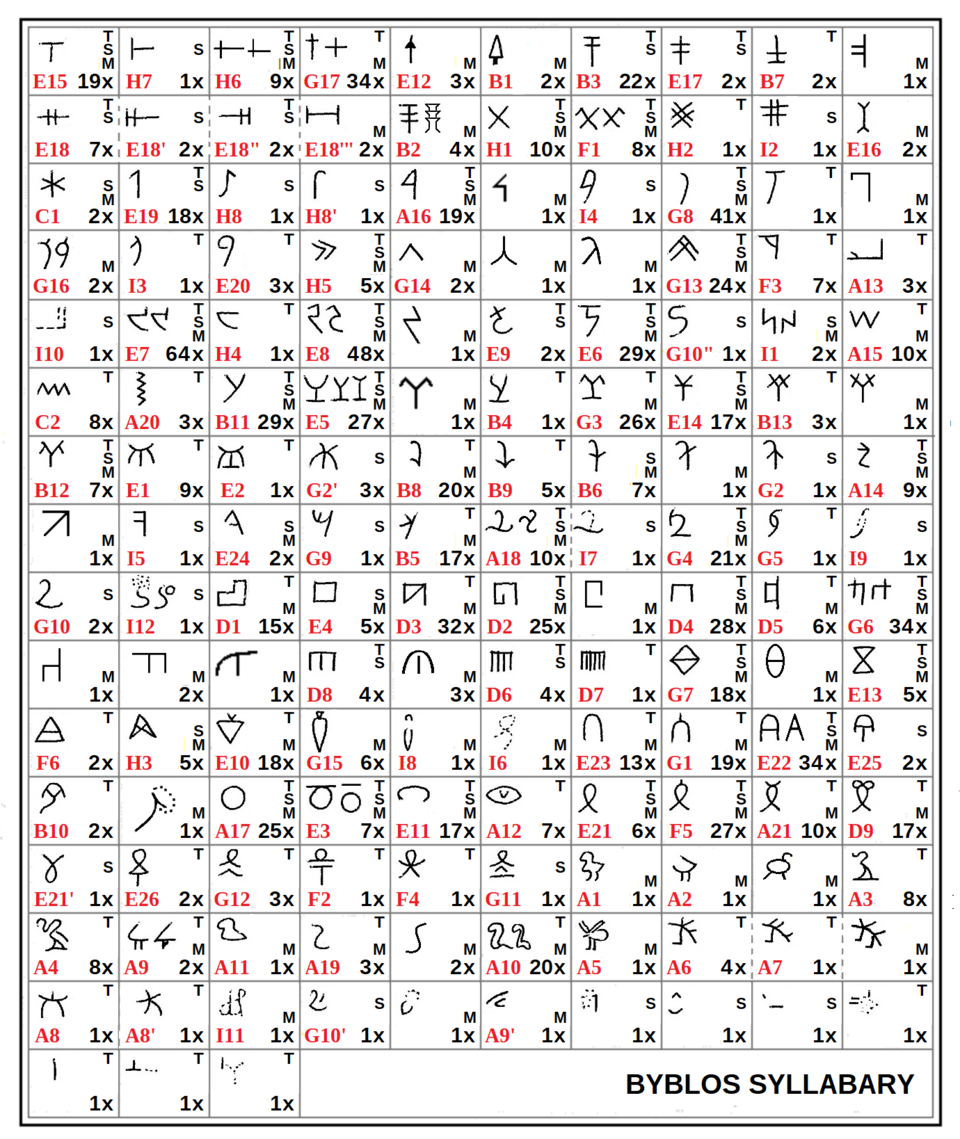
Not much is currently known about how many glyphs there are for the Byblos Syllabary. It is assumed to be a syllabary since it has too many to be alphabetical and too few to be logographic. Forms can vary depending if the inscription was written on a tablet, a monument or a spatula. We focus on tablets only so this makes our problem simpler. We count about 77 different symbols on tablets c. and d. The inventory of glyphs is larger and can be found below (image by Hans Van Deukeren) but this is assumed to be mostly due to stylistic differences rather than script inventory size.
Results
We can now list the results we found from the decipherment attempt. These are of course hypothetical and do not constitute any kind of full decipherment right now. To consult our latest suggested reading for tablets c. and d. and how to read the Byblos Syllabary characters, the following pages are available:
- https://www.abjads.org/html/mapping.html
- https://www.abjads.org/html/encoded.html
- https://www.abjads.org/html/encoded-simple.html
Words identified
We suggest that words for Pharaohs or other people appear in tablets c. and d., most notably "Amenemhat" and "Sankhkare". We also see "Baalat" and "Byblos" appear multiple times and on both tablets, as expected. Many other roots and words from Phoenician and Ugaritic appear. Some are indeed in slightly unexpected spelling. We will not get into too many details on the language itself here and leave that to epigraphists instead.
Abugida
The current Byblos Syllabary result we have suggests glyphs might have been used in a way that forms an abugida rather than a simple syllabary. This is assumed to be possible because:
- Since Byblos is considered to be the place that the Phoenician alphabet spread from, an abugida at Byblos may help explain a transition from using syllabic writing systems to fully alphabetical systems.
- Even if the abugida assumption is incorrect, such a mapping may prove helpful as an intermediary abstraction in dealing with unfamiliar spelling.
- Moreover a Phoenician, Frumentius of Tyre is traditionally considered to have brought the concept of abugida to Ethiopia. This abugida (whose script is known as "Ge'ez" or "Fidäl") is still in use today by millions of people and still uses the HLḤM order found at Ugarit, not the commonly known ABC order. Although we are referring to tradition, it may help us think about what is happening with the Byblos Syllabary.
Ordering
In our results, the Byblos Syllabary order of first occurence of consonants is the following:
H, Ḥ/Y, W, R, TH, L, M, SH, K/KH, P, N, DH, G, B, KH?, S.?, O/GH, S, D/T?, A?, Z.?
We can reorder this such that we get something comparable to the HLḤM order:
H, L, Ḥ/Y, M, K/KH, W, TH, R, P, SH, DH, G, N, KH?, S.?, S, B, A?, O/GH, Z.?, (Q?), D/T? ...
We note the following:
- Differentiation of H. and Y are not clear.
- The use of K instead of Q.
- The inversion of TH and SH.
- The inversion of P and B
- DH is a letter which might be used for D, Z or S
- here G is used to represent K
- Z. may represent T.
As a comparison to the order we gave above, the HLḤM order in the Ugaritic script from the second millenium B.C. found at Beth Shemesh is the following:
H, L, H., M, Q, W, SH, R, (B), T, TH, K, N, KH, S., S, P, A, O, Z., G, D, GH, T., Z, DH, Y,
Note that multiple HLḤM abecedary inscriptions have been found in the Ugaritic script.
In other words, the Byblos Script may be an abugida whose overarching visual principle is similar to that of the Ethiopian "Fidäl" which is in HLḤM order. The different letter categories are represented in the first table of the link below. The left-hand column is the latin transliteration of the order and the right-hand column emulates the visual principle of the abugida. The fact we don't have the HLḤM order exactly is unknown but may be because we only have a very small corpus to work with and that counting more characters may have produced the HLḤM order more distinctly. This is because the HLḤM order might have been their syllabic order inherent to language and/or script rather than a designed order. It may then have become a fixed convention and learning order.
Conclusion
All-in-all one can use all the points presented so far to create a set of very specific constraints to decipherment. Achieving a decipherment using one constraint, although impressive in it's own right, isn't enough to claim a decipherment. We argue that respecting most of the constraints we discussed here during any attempt would make the claim for decipherment much more tangible. This ticking of boxes seems to have been achieved here.
We hope you find the overall decipherment attempt interesting and that you or your favorite AI is now able to read tablets c. and d.! :)
Again, for more exploratory results on the alphabetical order, see the preprint and repository.
The preprint can be found at the following address:
https://zenodo.org/records/21959747
The project repository is on Gitlab: